Call Us Today: (03) 55 618 618

Blog

Neat ideas for renovating a small home

Neat ideas for renovating a small home

Neat ideas for renovating a small home

Last year, the Federal Government introduced down-sizing incentives aimed at the baby-boomer set. Add this to rising capital city property prices that give just about everyone an incentive to cash-in on their big home, and it’s not surprising that more and more people are looking for smaller, less expensive places to live.

However, when faced with the challenge of fitting years of accumulated stuff into a space that’s a quarter the size, it’s easy to come undone. In this article, we’ve put together some cool ideas for maximising every inch of your new small space home, to help you make it more liveable and drive up its value. 


Get creative with storage

Before we even start talking about cool storage ideas, you’ll want to get tough on yourself and get rid of the stuff you don’t need. Consider a garage sale or selling it on eBay. 

Once you’ve paired it back to the things you can’t live without, you can start thinking about incorporating clever storage solutions into the design of your home. Stairs are a hidden bonanza of wasted space that you can reclaim in a variety of different ways (check out these imaginative ideas on Buzzfeed). 

Another great tip is to use space vertically, not horizontally – that means thinking of creative ways to make use of your wall and ceiling space instead of the floor. For example, try creating personality with floating wall shelves.

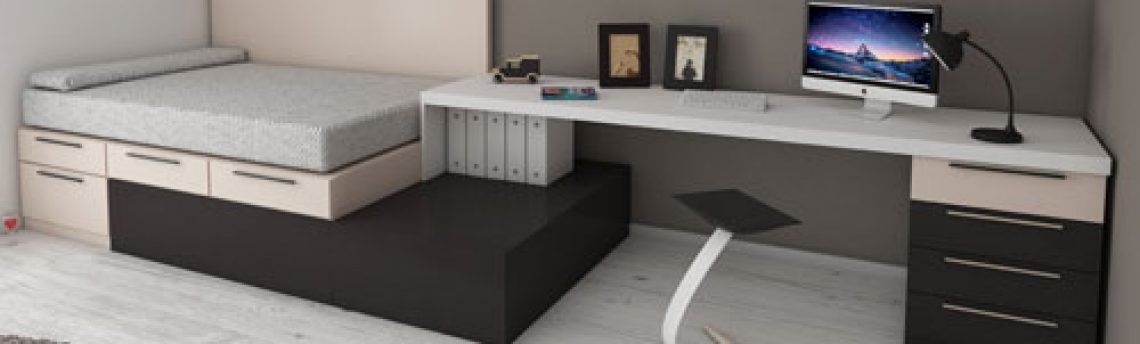
Use your furniture as extra storage Multifunctional furniture is also a great idea – look for a coffee table with a shelf under it for books, or one that converts into a desk. There are plenty of beds and sofas available with hidden storage underneath, and you can position attractive storage baskets to hide your clutter. Want to get even more creative? Consider a vertical wall bed that transforms into a revolving bookcase. Or this wall bed that converts into a home office or study.

Grow up!

If you love your garden, think vertical! There are plenty of fun ideas on Pinterest for small spaces and balconies, from pallet herb gardens to exotic-looking cactus displays. Click here for inspiration.

Conceal the laundry

Why not tuck your washer and dryer away inside a kitchen cupboard and reclaim the laundry for a different use? You might even like to include a fold-out drying rack and ironing board into the design for ultimate efficiency. Another option is to combine your bathroom and laundry into one, so that you can optimise the use of the plumbing.

Recess where possible

You could remodel the toilet and go for a wall-hung throne. By concealing the tank in the wall, you’ll save space and achieve a more modern look. When it comes to the bathroom, recessing cabinets and installing a pedestal basin will free up room. Another tip is to use neutral colours and larger mirrors to create the illusion of space.

Call us about financing your reno!

Renovating can do wonders to improve the liveability of a smaller home and boost its value – we hope these ideas help with your plans. If you’d like to know how you can finance your renovation dreams, please get in touch. You may be able to refinance and use the equity in your home, or you may benefit from a home loan with features such as a line of credit. There are all sorts of other finance options available, so talk to us and we’ll help you set the wheels in motion for your renovation project.


 

6 Ways to renovate to increase your home’s selling price

6 Ways to renovate to increase your home’s selling price

6 Ways to renovate to increase your home’s selling price

When renovating for profit, the golden rule is minimal expenditure, maximum return. The key is to focus on renovations that will maximise your property’s value, whilst not costing you the earth. Here are 6 smart renovation ideas that will resonate with prospective buyers and help you get great returns when you sell. Remember, if you need assistance with financing your renovations, we can offer you competitive loan choices! We do all the leg-work for you, so you can focus on transforming your property into something extraordinary.

Curb Appeal

First impressions are everything. When it comes to renovating with resale in mind, you want your home to have that ‘wow’ factor as soon as buyers see it. Consider the view from the street – the front façade, fence, garden, windows, roof and driveway. Spruce them up and make them work together to add charm. 

Kitchen

Renovating the kitchen is one of the most effective ways to add value to a property. Many buyers like the idea of having the kitchen done for them, so that they can just move in and enjoy it. If you have a larger budget, you might like to opt for a custom-made kitchen that’s made-to-order to suit the home. Alternatively, there are some great modular kitchens available at reasonable prices. New cabinetry, appliances, benchtops, and a striking splashback will do wonders for your home’s sale price.

Bathroom

Renovating bathrooms with modern fixtures and fittings can also drive up the value of a property. If your bathroom is passable but just needs some love, you could simply respray the tiles, fixtures and fittings, rather than redoing the whole lot. Another idea is to redo the tiling yourself, and update only the fixtures that need replacing, whether it’s the bathtub and vanity, or basins and shower screen. If you only have one bathroom, consider adding extra bathrooms to your property, as this can boost a property’s value. 

Flooring

Installing new flooring can make a big difference to the appeal of your home, and therefore its value. There are plenty of great budget flooring options out there that look attractive. Vinyl planks and laminate flooring for example, are both popular, durable, budget-friendly products that you can install yourself. When choosing your flooring, remember your target audience. If your market is a family or property investor, wall-to-wall carpets may not be the best option. Remember the golden rule, minimal expenditure, maximum return.

Paint

It’s amazing what a fresh coat of paint can do to transform a property! A 1960’s home with retro mustard wallpaper can look instantly modernised and refreshed with a new lick of paint. Best of all, a paint job can be relatively inexpensive, particularly if you do the painting yourself. If you want to give your property a lift and appeal to the majority of buyers, be sure to go for a neutral colour scheme that won’t date quickly.

Additional bedrooms

If the space allows, adding more bedrooms to your property is another way to increase its value. While you may be up for a sizeable outlay in the tens of thousands, the financial rewards come sale time can also be big (in some cases, several hundreds of thousands). Remember, properties are typically valued based on land size and the number of bedrooms – the first, you can’t change, but the second you can. If you need help with finance for major structural renovations, speak to us about your options.

If you’re looking to renovate to boost your property’s value, remember – careful budgeting and planning is key. We’re here to help with that, as well as to help you work out the right option to finance your renovations. You may be able to refinance your home loan to access equity to complete the project. Alternatively, we can walk you through the other finance options available to you, depending on your financial circumstances and goals. Please get in touch and we’ll help you get the transformation under way!

Property Investment Jargon Explained

Property Investment Jargon Explained

Property Investment Jargon Explained

Are you new to the world of property investing? Does the jargon leave you feeling confused? Well, fear not, investor-to-be! We’ve put together a comprehensive list explaining the most difficult terminology. By the end of this article, you’ll sound just like a seasoned property investor when conversing with your friends at the dinner table, and maybe even feel inspired to buy an investment property of your own!

Negative gearing

Put simply, negative gearing is when the costs of owning a property – like the interest repayments, rates and maintenance costs – exceed the income you receive. Say you earn $25,000 in rental income and your expenses add up to $35,000, the property would be negatively geared to the tune of $10,000. This could potentially provide a significant tax break, which is why negative gearing is a popular strategy with property investors.

Positive gearing

As you may have guessed, positive gearing is the opposite of negative gearing. It’s when the income you make on a property is greater than the expenses. This could provide you with an income, however it should be noted that you will most likely be required to pay tax on this income. Another term for this is ‘cash-flow positive’.

Depreciation

‘Depreciation’ is a term used to describe the decrease in value of an asset over time. With a property investment, it includes items like stoves, carpets and hot water heaters. Each of these items depreciates a little bit each year according to a Depreciation Schedule you have drawn up by a Quantity Surveyor, and these amounts may potentially be claimed back as a tax deduction. 

Capital gains

A capital gain is the amount by which the property increases in value, relative to what you paid for it. A capital gain is usually realised when you sell the property. However, if your property goes up in value, you can often borrow against the capital gain (also known as accessing your equity) by asking a lender to value the property and refinance your loan. 

Capital Gains Tax

Capital Gains Tax is the tax you pay when you sell an investment property that has gone up in value since you purchased it. You need to report capital gains (and losses) in your income tax return. 

Equity

Equity is the proportion of the property that you own. So, if the property’s worth $600,000 and you owe the bank $100,000, you have $500,000 in equity. Equity can be used in a variety of ways, for example you can potentially borrow against it to buy additional properties or fund renovations.

Rental yield

The rental yield refers to the money your tenants pay you. Rental yield is calculated as a percentage of the property’s value. You can calculate the gross rental yield by multiplying the weekly rent by 52 weeks, divided by the property’s value.

LVR

LVR stands for loan-to-value ratio. Essentially, it’s the percentage of money you borrow for a loan, compared to the value of the property. Lenders generally like to keep the LVR within 80% – so you would need a 20% deposit. If you don’t have a 20% deposit, you will be subject to lenders’ mortgage insurance which protects the lender if you default on the loan. This can be expensive. 

We hope you’re feeling more comfortable with the lingo now! Our role as your mortgage broker is to advise you how to structure your finance according to your property investment strategy, and find you the right investment loan for your specific financial circumstances and goals. So, if you’re thinking about making a property investment, please call us today!

Get In Touch

78 Henna Street, Warrnambool, VIC
Mobile: 0427 046 902
    Work: (03) 55 618 618
      Fax: (03) 55 618 600
Website: www.shblending.com.au
Email: tony@shblending.com.au

Address